
Beginner songwriters often ask the question, “lyrics first, or music first?” To them, it feels like a high-stakes choice, as if picking the “wrong” one dooms their song from the start.
But we dug into the processes of more than 30 legendary songwriters, from Paul McCartney and Dolly Parton to Taylor Swift and Kendrick Lamar, and the evidence is clear: there are three distinct paths to writing song lyrics, and even the greats switch lanes all the time.
This guide breaks down those three approaches, showing you how each one works, who uses it, and what you can steal from it. Let’s start with the writers who believe a song has to be a story before it can ever be a sound.
The Architects — When Words Build the World
This path is for the storytellers, poets, and conceptual thinkers. The lyrics serve as the blueprint, like the song’s DNA, containing its theme, mood, and rhythm. The music is then constructed to serve and elevate that lyrical foundation.
Leonard Cohen
Famous for his laborious, perfectionist approach to lyrics, Cohen would spend years on a single song’s words, writing dozens of verses before ever committing to a final melody. For him, the song wasn’t finished until the words were perfect gems, ready to be set to music.
“I wish I were one of those people who wrote songs quickly. But I’m not. So it takes me a great deal of time to find out what the song is.”
Stevie Nicks
Her process begins with poetry, meticulously captured in journals over decades. She is a collector of words and feelings first. The music’s role, which she finds at the piano, is to give that pre-existing poetry a voice and a melody to live in.
“That has always been my process since I was 15 years old… write a poem, and then that poem is something that… I will take to the piano.”
Kendrick Lamar
In a genre that is predominantly “beat-first,” Lamar stands out as a true architect. He often writes lyrics for months, crafting a narrative and a specific point of view before ever hearing a beat. The music must serve the story, not the other way around, ensuring his albums have a deep thematic cohesion.
“My process it start from just a whole bunch of premeditated thoughts… what I want to say next.”
Steal This Process:
- Write a short story or poem without worrying about rhyme or rhythm. Find the core emotion and build from there.
The Sculptors — Finding the Feeling in the Sound
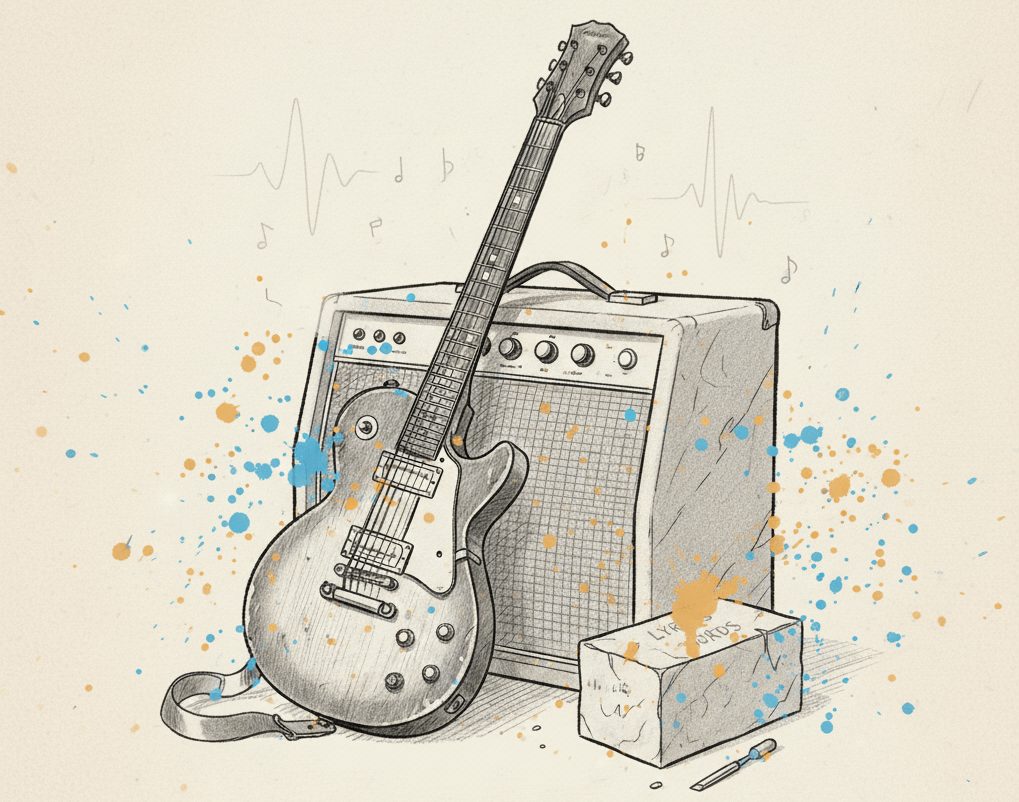
For these artists, a song starts with a sonic seed—a melody, a riff, a chord progression. The music is the raw marble and the songwriter’s job is to chip away at it, discovering the words that already seem to exist within the emotion of the sound.
Paul McCartney
The quintessential music-first story is Yesterday. The melody famously arrived in a dream, so fully formed that he initially thought he had plagiarized it. The iconic lyrics about loss came much, much later; for over a year, he used the placeholder “Scrambled eggs… oh my baby how I love your legs” just to have something to sing.
“Most of the time, if you’re lucky, they [music and lyrics] come together. You just sit down and start… blocking stuff out with sounds.”
Kurt Cobain
Nirvana’s sound was built on powerful, unforgettable guitar riffs. Cobain consistently started with the music and a vocal melody, often using gibberish or mumbles as placeholder lyrics until the last possible moment before recording. The feeling came from the sound, and the words followed.
“I write the lyrics usually minutes before we record.”
Brian Wilson
As the architect of The Beach Boys’ complex sound, Wilson’s process was unambiguous. He built the intricate musical and harmonic structures first, creating a complete sonic world. Only then would he and his collaborators work to fill that world with the right words.
“Usually, the music comes first. Then, I write the lyrics over the melody.”
Brian Wilson Revealed His Creative Process (American Songwriter)
Steal This Process:
- Spend 15 minutes recording any and all musical ideas that come to you—short riffs, beats, melodies. Don’t judge, just capture.

The Weavers — The Modern, “Third Way”
This is the symbiotic, iterative path where music and lyrics evolve together in a constant feedback loop. Amplified by modern technology, this process often follows a new sequence: Production → Melody → Lyrics. The lines between writing, arranging, and producing become completely blurred.
Billie Eilish & FINNEAS
Their workflow is a fluid “relay race”. FINNEAS might create a beat or an instrumental texture, and Billie improvises vocal melodies and lyrical ideas over it. They build the song together, layer by layer, with the production itself sparking lyrical and melodic ideas in real-time.
“I’d be in my studio and I’d be working on the instrumental stuff and she’d [sing] a vocal… we’d put some processing on it [so] she was able to sing with that while we were writing the song.”
Finneas Writing and Producing ‘BIRDS OF A FEATHER’ by Billie Eilish
Taylor Swift
Perhaps the most versatile modern songwriter, Swift uses all three methods. She might start with a fully-formed lyric from her journal, a chord progression on the guitar, or, most often, a fragment where words and melody are already fused into a single hook. For her, there are no rules.
On writing the chorus for Tim McGraw: “In my head it all came at once as a phrase with the melody and words.”
Thom Yorke
As Radiohead evolved, their process shifted from band jams to a studio-centric approach. Yorke began to treat songwriting like creating a collage, building tracks from sonic fragments and letting the lyrics emerge from the soundscape itself, sometimes by literally cutting up phrases and pulling them from a hat.
“A lot of the songwriting now isn’t really about songwriting at all, it’s about editing, building up a lot of material, then piecing it together like a painter.”
Steal This Process:
- Use a simple beat or drum loop as a writing partner. Let the groove suggest a vocal rhythm and write one line of a lyric, then let that line inspire the next melody, using a guitar, piano, or your voice.
Sidebar: Four Songwriting Myths, Busted
-
Myth: Paul McCartney’s “Yesterday” arrived complete in a dream.
Reality: Only the melody arrived in a dream. He used the placeholder lyrics “Scrambled Eggs” for over a year and spent weeks finalizing the actual words. -
Myth: Kurt Cobain’s lyrics were meaningless nonsense he didn’t care about.
Reality: While he often wrote lyrics last-minute, his private journals show he was a meticulous collector of phrases. The lyrics were deeply personal, just assembled under pressure. -
Myth: Elton John and Bernie Taupin write songs together in the same room.
Reality: Their process is famously separate. Taupin writes lyrics alone and sends them to John, who then composes the music in isolation. They have maintained this rigid lyrics-first pipeline for over 50 years. -
Myth: Jay-Z freestyles his albums off the top of his head.
Reality: He doesn’t write on paper, but he also doesn’t improvise the final take. He mentally composes, edits, and memorizes entire verses before performing them from memory—a feat of organization, not just improvisation.
The One Habit They All Share
So we have the Architects, the Sculptors, and the Weavers. But cutting across all three paths is a more fundamental identity: the fragment collector. The most prolific songwriters don’t start from a blank page. They start from a library of ideas they’ve been capturing for years.
They are obsessive collectors of stray parts, trusting that a home will be found for them later.
- Taylor Swift calls them “zingers” she collects in an “endless note-thing” on her phone.
- Stevie Nicks’ journals are treasure troves of poems and phrases waiting to be paired with a melody.
- Kurt Cobain’s private journals, which contradicted his “I don’t care” myth, were filled with lyrical ideas and conceptual scraps.
- Dolly Parton is famously ready to capture an idea on anything, even a McDonald’s receipt, and keeps “boxes and trunks full” of song ideas.
Songwriting is a lifelong habit of observation and capture. This is why having a system to hold onto a hummed melody, a line of overheard conversation, a dope bar, or a cool chord change is so important. Because no matter which path you take on a given day, you’ll need raw materials to build with.
What Process is the Best?
The real question isn’t “lyrics or music first?” It’s “what does this particular idea need?” The goal isn’t to pick a camp and stay there, but to understand the different ways a song can begin so you can choose the one that fits the moment.
Ultimately, the one secret that isn’t a secret is that every single one of these artists has a system to capture ideas immediately. The most critical step in songwriting isn’t the first line or the first chord—it’s the first feeling. Get that feeling down in the quickest way you can so you don’t lose it and now you have the seed of a song.
Your process is your own. It can start with a story, a sound, or a loop. It can change from song to song. The best way to start is simply to start. And instead of staring at a blank page, start with a feeling.
Download Spit Notes to start collecting and organizing song ideas today.